Ambient Solves an Operations Problem First
A proxy update in the sidecar model means: every pod restarts, or someone stacks the maintenance windows of twenty teams on top of each other.
- Date
- Topic
- Ambient
- Sources
- 4
- Reading time
- 2 min
- Version
- Translation
People argue about Istio Ambient as if it were a feature. Yet its real promise does not appear in any feature table. An operations promise.
Figure as text
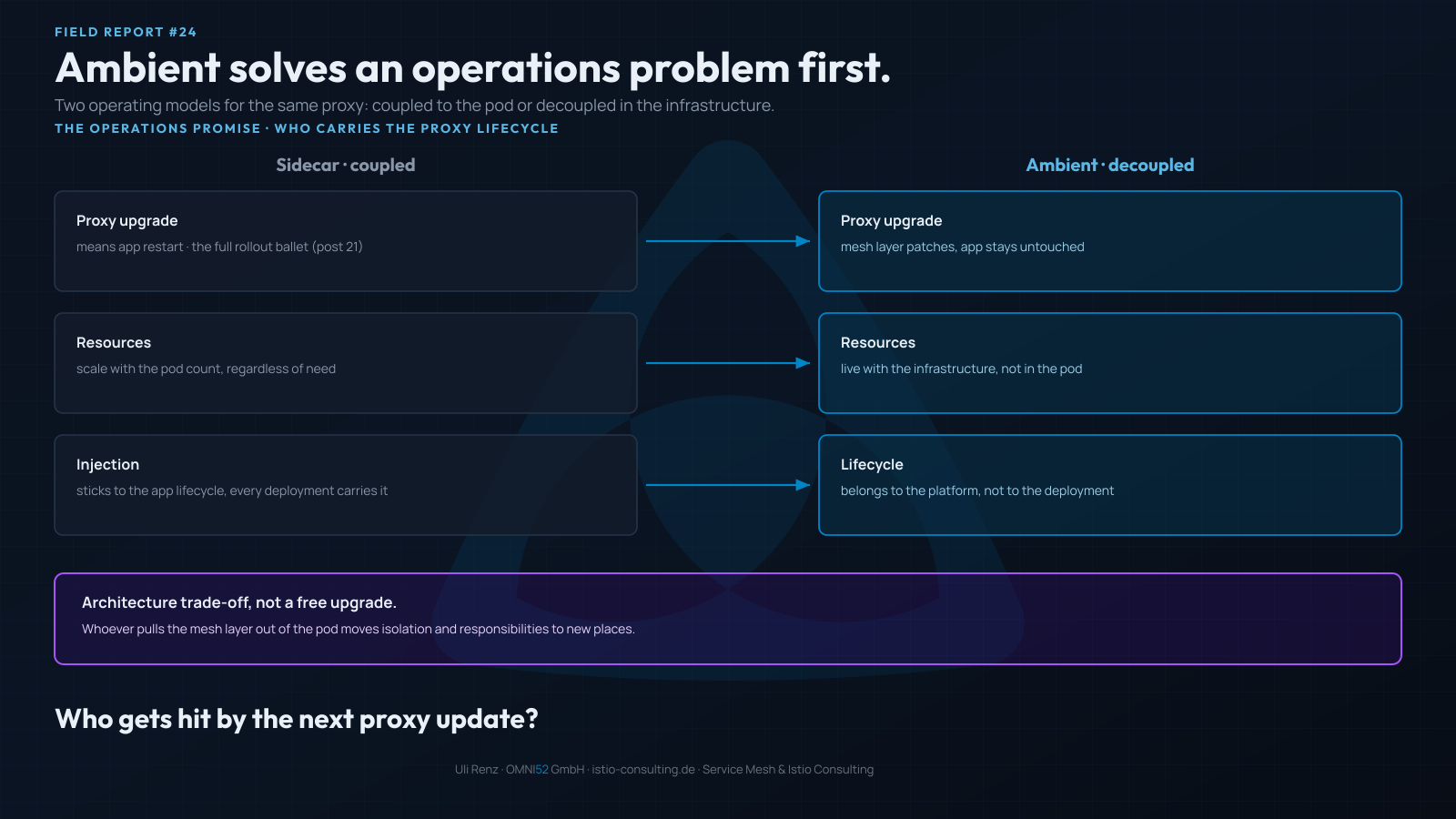
Side-by-side comparison of two operating models for the same proxy: on the left, the sidecar model, coupled to the pod (proxy upgrade means app restart, resources scale with the number of pods, injection sticks to the app lifecycle); on the right, Ambient, decoupled in the infrastructure (mesh layer patches without app restart, resources sit with the infrastructure, lifecycle belongs to the platform). Below, the note: architecture trade-off, not a free upgrade; pulling the mesh layer out of the pod moves isolation and responsibilities to new places. Punchline: whose calendar does a proxy update cost?
Look at any sidecar cluster. The proxy is tied to the pod, and this coupling runs through all of operations: a proxy upgrade means an app restart, the complete rollout ballet (report #21). The proxy resources scale with the number of pods, regardless of whether the workload needs a lot from the mesh or almost nothing. And injection sticks to the app lifecycle: every deployment carries its own mesh layer through every environment.
Ambient turns this coupling around. The mesh layer moves out of the pod and into the infrastructure. The proxy then belongs entirely to the platform, and so does its lifecycle. A mesh upgrade no longer needs an app restart. Still, the ztunnel upgrade briefly interrupts traffic on the node, long-lived connections in particular (report #21). That is why platform teams run it like a node upgrade: cordon, drain, node by node.
For decision makers, this is the real news. The question “who has to redeploy when the platform patches” disappears, and with it the calendar Tetris of maintenance windows and alignment meetings. If you have ever coordinated a critical mesh upgrade across a hundred deployments, you know what that is worth. A coordination problem becomes a platform procedure.
The catch: this is an architecture trade-off, not a free upgrade. If you pull the mesh layer out of the pod, you move isolation, responsibilities and failure modes to new places. Where they land is what we will look at over the coming weeks. Soberly, without picking a camp.
Who gets hit by the next proxy update? That is a question Ambient answers first.
Next week we go under the hood: how Ambient splits the work of a sidecar across two components, and why only one of them is an Envoy.